
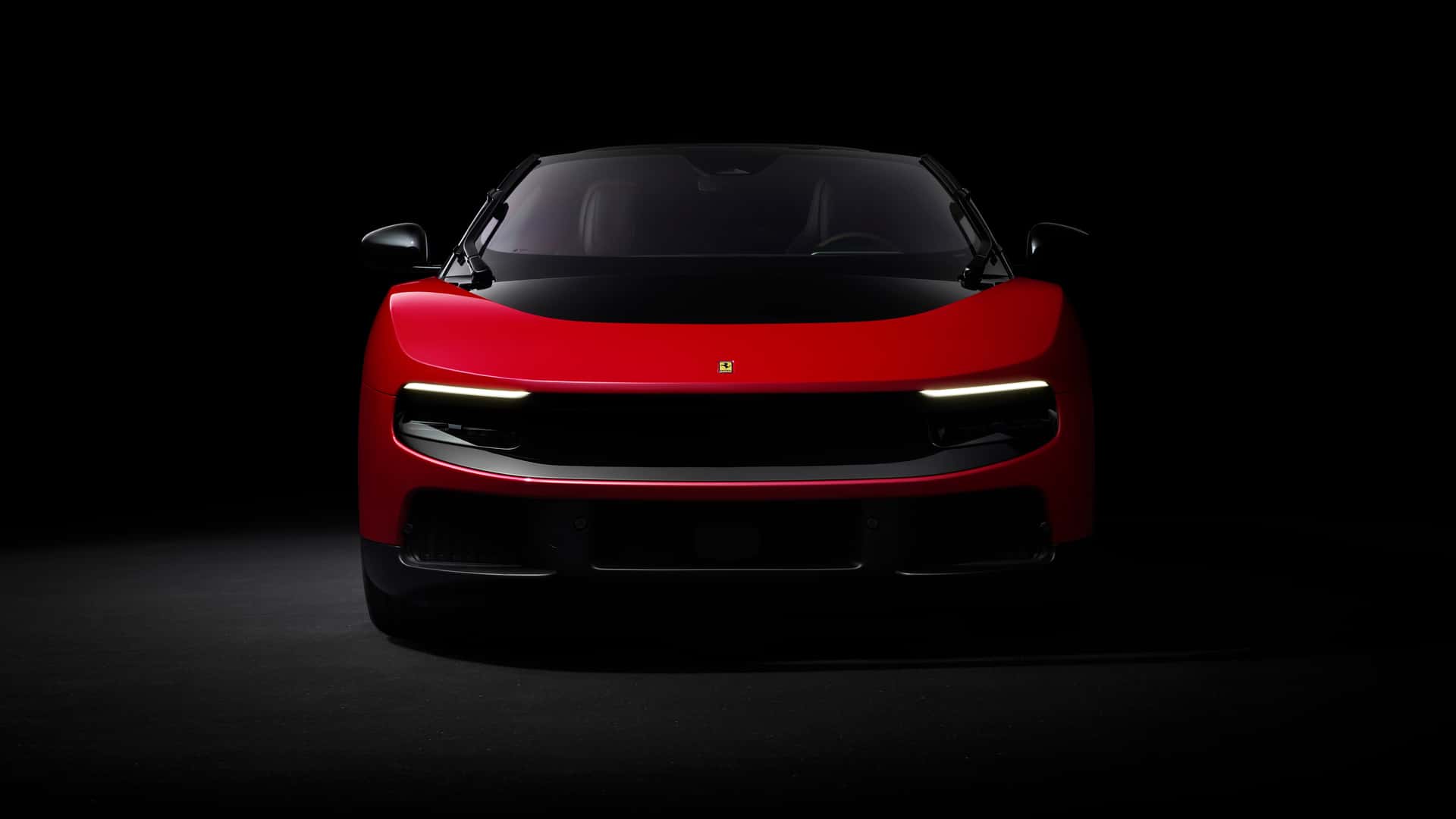
Back in February, when Ferrari showed only the inside of the Luce, I did two things. I put a number on the price, and I deliberately refused to judge the car. The number I was willing to commit to. The verdict I was not, because you cannot judge a car you have only seen from the driver’s seat outward, and you certainly cannot judge one in the first hour after its reveal, when everyone is performing a reaction rather than forming an opinion.
So I waited. The full car appeared at the end of May, in a light show outside Rome, in front of two hundred journalists, and it was met almost immediately with ridicule, a former chairman warning of the “destruction of a myth,” and a share price that fell hard. It would have been easy to write something that same week. It would also have been close to worthless. Launch day is theatre. It tells you how a machine makes people feel in the first sixty seconds, which is real but not the same as important. A month later, most of that noise has drained away and left a few things worth looking at. This is the post I couldn’t responsibly write in May.

First, the boring vindication
The pricing was the easy part, and it held. I had suggested a base somewhere between €450,000 and €550,000, with most cars leaving the factory north of €600,000 once options were counted. Ferrari set the base at €550,000, and a fully specified car climbs toward $725,000. That is not clairvoyance; it is just what happens when you read a company’s margin logic instead of its marketing. I mention it only because it buys the right to be taken seriously on the harder question, which is the design — and there I am a good deal less comfortable.
The shape people can’t forgive

Let me not pretend the critics are inventing their objection. The Luce is a five-metre, five-seat, five-door liftback with rear coach doors and a cabin pushed forward on the body. By almost every convention that makes a car read as fast and special — the long bonnet, the cabin set well back, the low roofline, the sense that the whole thing is crouching — it does the opposite. When people reach for the Multipla as a comparison, they are not only being cruel; they are making a genuine point about proportion. If you love the classic sports-car silhouette, and Ferrari owners tend to, your first reaction to this car will not be warm. Mine wasn’t either.
But there is a distinction worth holding onto, because it is the whole argument. Breaking the rules is not the same as having no rules. The conventions the Luce ignores are conventions of the combustion era — proportions that exist to celebrate an engine sitting under a long bonnet. Take the engine away and that long bonnet loses its reason to exist. It no longer has to describe anything.

Here is the correction I want to make to the lazy version of my own argument, though, because it is the version I nearly wrote: electrification removing the reason for the old proportions is not the same as electrification forcing the new ones. A battery in the floor does not dictate a tall five-seat liftback. Porsche built the Taycan low and sleek on exactly this kind of architecture; Maserati did the same with the GranTurismo Folgore; the low, wide, crouching silhouette is entirely available to an electric car if that is what you want. Ferrari did not want it. It chose a five-metre, five-seat, genuinely usable body because it was deliberately entering a new segment, not because physics left it no other option. That distinction matters, because it moves the car from “they had no choice” to “they made a choice” — and the second is a far stronger place to stand than the first.
What Ferrari’s own Centro Stile and LoveFrom — Jony Ive and Marc Newson’s studio, the same hands that shaped the interior — did with that choice was import a different discipline: the logic of product design, where the values are clarity, restraint, and honesty about what the object actually is. You can see it working. The glass-led greenhouse and the “flying bridge” C-pillar, where the roofline appears to float free of the body rather than meeting it, are a genuinely new and resolved idea, not a quotation of an existing one. You can also see where it does not work: the cabin is set so far forward, and the tail carries so much visual mass, that from certain angles the car looks like it is sitting down at the back rather than coiled to launch. It is a coherent rulebook — just not the automotive one, and watching a car get judged by the wrong rulebook is disorienting.
I think that swap was deliberate, and I think it serves two purposes at once. The first is simply to imagine a different future rather than a nostalgic one — to build the car you would see in a film set in 2075, not an electric costume worn over a twentieth-century idea. The second is subtler and, to me, the more interesting. By making the electric Ferrari conspicuously unlike the combustion Ferraris, Maranello quarantines the thing its customers are most afraid of losing. The V12s do not have to pretend nothing has changed, because the change has been given its own body, its own name, its own face. It is a way of launching a second identity without the cost and dilution of launching a second brand.
That is the charitable reading, and I hold it sincerely. I will also say plainly where it might fail. A rule-swap only works if the new rules are applied with total conviction, and parts of the Luce look caught between two worlds rather than committed to one. When it is confident, it looks like the future. When it hedges, it just looks heavy. Whether it ages into an icon or into a punchline depends entirely on which of those two the car mostly is, and on that I genuinely don’t know yet. Anyone who claims certainty in either direction is guessing.

The machine the argument skipped past
Lost in all of this is that the Luce is, mechanically, a serious piece of engineering, and almost nobody arguing about its face has bothered to look underneath it. It runs four motors, one per wheel, for just over 1,000 horsepower and all-wheel drive, with the torque split heavily to the rear so it behaves like a rear-driven Ferrari rather than a numb all-paw appliance. Ferrari quotes 0 to 100 km/h in 2.5 seconds and a top speed beyond 310 km/h. The 122 kWh battery runs at 800 volts, takes on charge at up to 350 kW, is built as a structural part of the chassis rather than a slab bolted underneath, and returns a little over 500 km on the WLTP cycle. There is rear-wheel steering, torque vectoring, and active suspension. This is not a badge glued to a generic skateboard; it is a properly engineered car, and the people dismissing it from a single three-quarter photograph are missing that entirely.
It is also, and I am not going to pretend otherwise, a heavy one: 2,260 kg. Ferrari’s founding instinct, the one that goes back to Enzo, was to add lightness — to make the car do more with less mass. A 2.26-tonne Ferrari is a real philosophical departure, arguably a bigger one than the way it looks, and much of that active-chassis hardware exists precisely to disguise a weight the old Ferrari would simply have refused to carry. Whether clever electronics can make two-and-a-quarter tonnes feel genuinely alive is the real engineering question here, and it is a far more interesting one than whether the C-pillar is pretty.
What the market actually said, as opposed to what it seemed to say
The number everyone repeated was the fall: down around 8% in Milan, over 5% on the New York listing, something like €4.5bn of value gone in a day. Frightening, until you put one fact next to it. That same day, the broad American market was not down at all — it rose to a record high. So whatever pushed Ferrari’s shares down, it wasn’t the weather. The entire move was specific to this one company and this one car. On the face of it, that looks damning.
Except the stock had also climbed steeply into the launch, on months of anticipation, and there is an old and reliable pattern in markets: people buy the rumour and sell the fact. The reveal is the moment the anticipation trade closes, almost regardless of what is revealed. And then look at what happened next, which almost nobody reported because a recovery is not a story. The shares began climbing back the following day. Within about a week they were roughly where they had started. By late June they were trading above the pre-reveal level. The €4.5bn headline had a shelf life measured in days. The more sober analysts, as opposed to the launch-day crowd, told their clients not to overreact, and pointed to 2022, when the Purosangue drew exactly this “that isn’t a Ferrari” panic and then became one of the company’s best-selling and most waitlisted cars.
I want to be careful here, because a recovering share price is not proof that the design is good. It only proves that the sell-off was mostly positioning, not a considered judgment on the product. The considered judgment lives in the order book over the next year or two, and until a few weeks ago that data did not exist at all. Now the very first sliver of it does, and it is worth looking at on its own. What the market gave us in May was an emotion with a decimal point, and it has already taken most of it back.
The first fragment of the order book
I said the real verdict lives in the order book, and the first fragment of it has appeared — from China, which is not where I would have looked first. Ferrari allocated 88 cars to the Chinese market, priced at ¥3,988,000, about €520,000, which is oddly around 7% cheaper than Europe rather than the usual imported-Ferrari premium. Within hours, the allocation was reported sold out. I want to be careful with that phrase, because at least one Beijing report has Ferrari’s own sales staff saying the car is still orderable ahead of its Beijing debut in early July, so “gone in hours” may be doing some marketing work. But even discounted, the signal is clear enough: the most controversial Ferrari in recent memory found its buyers quickly, in the one market that has been loudest about disliking how it looks.
Here is the part worth sitting with, because it cuts against the easy conclusion. That demand is not evidence the design is good. If anything, the Chinese commentary makes the opposite case with startling honesty. There the Luce has been nicknamed “4 million yuan on wheels,” and the reasoning is explicit: the controversy is the point. A car everyone is arguing about, that costs this much, that is electric in a country full of faster and cheaper electric cars, marks its owner instantly as someone for whom the price is irrelevant. As one widely shared line put it, the electric car is free — what is being sold is the badge. On paper the Luce is beaten by domestic machines like BYD’s Yangwang U9 on both performance and charging, and none of that matters, because nobody in this buyer set is shopping on specification.
So the early sell-out tells me something real and something limited. The real part: Ferrari’s scarcity and brand power are completely intact, backlash notwithstanding — which is exactly the muscle that had to survive the move to electric, and it did. The limited part: strong launch demand, driven partly by status and partly by scarcity, is not the same as a design that will be loved, or that will hold its value once it stops being novel. Ferrari itself seems alert to this. When rumours circulated that the company was nudging its best clients to buy a Luce to improve their odds of being offered future limited editions, its commercial chief denied it flatly, and explained why in terms of pure self-interest: a reluctant owner becomes a “negative ambassador” who badmouths the car and resells it, destroying the residual value that the luxury-EV segment is already struggling to protect. That is a company that understands the difference between selling 88 cars and building a legend, and is worried about precisely the right thing.
The Apple pattern is older and stranger than people remember
There is a longer precedent worth setting beside this one, and it is not the flattering version people reach for. For most of the last twenty-five years, Apple’s stock fell on the very announcements we now file under history. The original iPod, in 2001 — the product that arguably saved the company — was openly mocked at launch as overpriced, under-featured, and short on storage next to its rivals; the shares dropped two days running and took the better part of a month to climb back. The 2005 Macworld keynote knocked 6% off. The MacBook Air, the iPhone 3G, the iPhone 4 — a shrug or a sell-off each time. The one clean exception in the early run was the first iPhone. And yet in the twelve months after the iMac, the iPod, the iPhone, and the iPad, the stock rose, sometimes dramatically.
The lesson is not “the Luce is the next iPod.” That is the seductive, lazy version, and I distrust it, because for every derided product that was later vindicated there is another that was derided and simply deserved it. The honest lesson is narrower and more useful: launch-day derision and a first-week sell-off carry almost no predictive information. Crowds are superb at reacting and poor at forecasting the second- and third-order value of something that breaks a category, precisely because a broken category has no obvious comparison to reason from. There is a further rhyme that is hard to ignore — the people who shaped the Luce, Ive and Newson, are quite literally of that lineage, and their design philosophy has a long record of being under-rated on the day and re-appraised later. That guarantees nothing. It only argues that the confident dismissals should be read with suspicion, not adopted.
The loudest critic, and why his verdict needs an asterisk
The single most quoted line came from Luca di Montezemolo, who ran Ferrari for twenty-three years and said the Luce risks the destruction of a myth. Coming from him, it lands, and it should be weighed. It should also be weighed with everything attached to it.
The merit in it is real. He, more than almost anyone, built the modern Ferrari mystique, and the emotional core of his objection — that a Ferrari stripped of the sound and violence of a combustion engine loses something that cannot simply be re-engineered back in — is not sentimental nonsense. Electric power does remove part of the theatre. That loss is genuine, and no amount of clever framing reduces it to zero. On that narrow point he is right, and so are a lot of the enthusiasts standing behind him.
Except that this is also where the engineering quietly answers him. The obvious cheap move would have been to pipe a synthesised V12 through the speakers, the way most electric performance cars fake an engine they no longer have. Ferrari refused to. The Luce takes the actual mechanical sound its electric drivetrain actually makes and amplifies it, tuned to the driving mode — an honest new voice rather than a recording of an old one. You are allowed to decide that is not enough for you. You are not allowed to call it lazy. It is a deliberate attempt to work out what a Ferrari sounds like when it is being truthful about what it now is, and that is a more serious answer to the “no soul” charge than the charge itself usually bothers to be.
The context is where the asterisk goes. He is not a neutral observer of this company. He spent his tenure capping production to protect exclusivity and warning that higher volumes would cheapen the brand; after he left, the volumes rose substantially and Ferrari became far more valuable rather than less, which makes his record as a forecaster of brand harm, to put it gently, mixed. He also spent years publicly insisting that Ferrari would never build a fully electric car at all. And he did not leave Maranello of his own accord; he was moved aside by the ownership that now runs it. A former chairman predicting that his successors’ flagship will ruin the company is not delivering a fresh assessment. He is continuing an argument he staked out long ago, against people who carried on without him. None of that makes him wrong. It does mean his verdict is closer to a position than a judgment, and it deserves to be read as one.
Where a month of distance leaves it
So: the pricing was disciplined and correct, the market has quietly unwound most of its first reaction, and the first 88 buyers have already put their money down — though 88 cars is a headline, not a verdict. The design is a real gamble, and I won’t dress it up as anything else — it breaks the rules that make a Ferrari instantly legible, it will lose some people permanently, and parts of it are not yet convincing on their own terms. But it breaks those rules on purpose, in the service of an idea that is at least coherent: give the electric future its own face, so the rest of Ferrari doesn’t have to distort itself to accommodate it.
Whether the execution is good enough to make that idea age well, I don’t know, and neither does anyone shouting from either side a month after a light show. What I am confident of is that the first hour was the worst possible moment to decide, and most people decided anyway. The number that will actually matter is not the share price on reveal day. It is the order book in 2027.
In February I called the interior a translation rather than a betrayal. The exterior is a harder sentence in the same language. It will take a year of listening before we know whether it’s fluent, or merely foreign.
Leave a Reply